Brand: A Handwritten Font Designed for Life’s Most Meaningful Moments
Choosing the right typeface for a wedding invitation, birthday announcement, or milestone celebration often feels deceptively simple—until you start browsing options. Many fonts either lean too formal and distant or too casual and lose the sense of occasion. Brand enters that space with a clear purpose: it is a unique handwritten font built specifically for special events such as weddings and birthdays. Rather than trying to be everything to everyone, Brand focuses on delivering warmth, personality, and legibility where it matters most. For anyone who has ever struggled to find a typeface that feels both personal and polished, Brand offers a thoughtful alternative worth evaluating on its own terms.
What Brand Actually Is—and Why It Deserves Attention
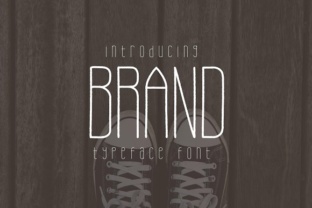
At its core, Brand is a handwritten script font that mimics the natural flow of hand lettering. Unlike many decorative scripts that prioritize aesthetics over readability, Brand maintains a careful balance between expressive character and practical clarity. Each glyph carries subtle variation in stroke weight and slant, giving it an organic feel without drifting into illegibility. The font includes uppercase and lowercase letters, numerals, punctuation, and a selection of ligatures that help avoid awkward letter combinations common in script typefaces.
What makes Brand worth discussing is not novelty alone—it’s the deliberate design choices that serve its intended use case. The lowercase letters are compact enough to set comfortably in longer lines of text, yet each character retains enough flourish to feel celebratory. The uppercase set is ornamental but not overstated, making it suitable for names, headings, and short phrases. This combination is surprisingly rare. Many handwritten fonts either sacrifice readability for flair or strip away character to the point of blandness. Brand sidesteps both pitfalls by keeping the user’s audience and context front and center.
Key Characteristics and Practical Strengths
When evaluating any font, the real question is how it performs under realistic conditions. Brand holds up well across several dimensions that matter to designers, event planners, and business owners alike.
Readability at Multiple Sizes
Script fonts often fail at smaller sizes because closed counters, narrow spacing, or excessive swashes make individual letters hard to distinguish. Brand avoids this by maintaining generous x-height and moderate letter spacing. At 12 to 14 points, it remains readable for address blocks, RSVP details, or short paragraphs on a printed invite. At larger display sizes, the handwritten quality becomes more pronounced without losing structure. This flexibility means the same font can carry a project from headline to footer without needing a secondary typeface.
Consistency and Reliability Across Characters
One common issue with handwritten fonts is inconsistent stroke weight, which can look charming in isolation but distracting across a full page. Brand delivers a uniform baseline and consistent pressure profile. Ascenders and descenders are proportional, and the looped letters—a, b, d, g, p, q—behave predictably. This reliability reduces the time spent manually kerning or adjusting individual letters, a practical advantage for anyone working under tight deadlines or producing multiple pieces within the same brand system.
Ligatures and Character Alternatives
Brand includes standard ligatures for common letter pairs like ff, fi, fl, and Th, which help avoid the clunky collisions that can plague script types. These ligatures are not overly aggressive; they smooth transitions without making the text feel mechanical. Having these built in eliminates the need for manual tweaking in most standard layouts, which is a genuine time-saver for production work.
Real-World Performance Across Common Applications
To understand whether Brand lives up to its promise, it helps to consider the specific scenarios where it is most likely to be used.
Wedding Stationery and Formal Invitations
Weddings remain the primary use case for Brand, and the font suits the occasion well. On a classic white or cream card stock, Brand produces an elegant but approachable look. The bride and groom names set in uppercase with the rest of the text in lowercase reads naturally—formal enough to feel respectful of the event, yet relaxed enough to avoid stiffness. When paired with a simple serif for body details like time and location, Brand holds its own without overwhelming the layout. For wedding suites that include response cards, direction cards, and thank-you notes, the font’s consistency across formats helps maintain a cohesive visual identity.
Birthday Invitations and Party Branding
Birthdays, especially milestone ones, call for a personal touch. Brand works well for children’s parties when kept at larger sizes and combined with bright colors, but it really shines for adult celebrations—30th, 40th, 50th—where the host wants something with character but not childish. A simple invitation reading “Celebrating 40 Years of Erin” set in Brand feels celebratory without being cartoonish. The same font can be used on banners, menus, or signage for a consistent party theme.
Small Business and Creator Use
Entrepreneurs and small business owners often need fonts that work across multiple touchpoints. Brand is a solid candidate for boutique brands in event planning, floristry, baking, calligraphy services, or lifestyle coaching. It can appear on website headers, social media graphics, product packaging, and printed collateral without losing its personality. Because the font is legible at mid-range sizes, it can even be used for short product descriptions or taglines. However, for longer body text—anything beyond a paragraph—users should pair Brand with a plain sans-serif or serif to maintain readability.
Who Benefits Most from Brand
Understanding the audience a font serves is just as important as evaluating its aesthetic merits. Brand is not a one-size-fits-all solution, and that is a strength, not a limitation.
- Event planners and wedding designers will appreciate the font’s ability to carry a theme across paper goods without requiring multiple font licenses. Its reliability in print reduces the risk of last-minute layout failures.
- Freelance graphic designers and stationery makers can use Brand as a go-to suggestion for clients who want a handwritten feel but lack the budget for custom hand-lettering. It offers a professional-grade result with less production time.
- Bloggers and content creators in lifestyle, parenting, or DIY niches can use Brand for social media quotes, pin graphics, and email headers. The font adds warmth without detracting from the message.
- Small business owners who manage their own branding may find Brand particularly useful if they need a consistent voice across print and digital materials without hiring a designer for every project.
On the other hand, Brand is less ideal for corporate communications, formal legal documents, academic papers, or any context requiring a strictly neutral or highly authoritative tone. Its designed personality is purposeful, and using it in the wrong context can undermine credibility. This is not a flaw—it simply means the user should evaluate the project’s tone before committing.
Practical Recommendations for Getting the Most Out of Brand
Based on hands-on usage and observation, a few practices help leverage Brand effectively.
- Pair it with a neutral sans-serif like Open Sans, Lato, or Montserrat for body copy. This creates visual contrast while preserving readability for guests or readers who need to absorb details.
- Avoid all-caps for long phrases. Brand’s uppercase letters are beautiful but designed for emphasis, not extended passages. Use title case or sentence case for anything beyond three or four words.
- Test print before committing. Handwritten fonts can behave differently on coated versus uncoated paper, especially at small sizes. A proof print will reveal any spacing or legibility issues early.
- Use the ligature feature in your design software. Applications like Adobe InDesign, Illustrator, or even Canva support OpenType features. Enabling ligatures ensures the font’s built-in refinements are active.
Quality, Presentation, and Long-Term Value
Brand is not a free font, and that fact is worth noting. Its price point places it in the premium script category, but it competes well with similar offerings. The glyph set is complete, the kerning tables are well-tuned, and the font file works across both Windows and macOS without issue. Licensing terms typically cover standard use, but users should verify whether commercial or extended licensing is required for merchandise or large-scale print runs. For a font intended for special events—where the final product is often printed once and kept as a keepsake—the investment is reasonable, especially for professionals who will use it across multiple projects.
In terms of long-term value, Brand holds up stylistically. Script fonts tied to fleeting trends can feel dated within a few years. Brand leans classic rather than trendy, with letterforms that echo traditional calligraphy without replicating a specific historical period. This increases the likelihood that a wedding suite or brand identity created today will still look appropriate five or ten years down the line. For a font marketed around life’s important moments, that durability matters.
Possible Limitations to Consider
No font is perfect, and a balanced evaluation requires acknowledging where Brand may fall short for some users. The most common limitation is its character set. While adequate for English and many European languages, users needing extensive diacritics or non-Latin scripts will find the coverage limited. Additionally, the font’s handwritten nature means it does not offer the same optical sizing or multiple weights that a more robust type family provides. Users expecting a full range of thin, regular, bold, and black variants will need to look elsewhere. Brand is a single-weight script, and its versatility depends on thoughtful pairing rather than internal variation.
Another practical consideration is screen rendering. At very small sizes on low-resolution displays, the fine details of the strokes may soften or blur. For digital-only projects that will be viewed on mobile devices, Brand works best at display sizes or in headings where the pixel count can support the subtleties of the design. For body text on screens, a simpler font is safer.
Final Perspective on Brand’s Place in a Designer’s Toolkit
Brand succeeds because it understands its own purpose. It does not try to be a workhorse for every project, nor does it compromise its character to appeal to the broadest possible audience. Instead, it serves a specific need—celebratory, personal, handwritten communication—and serves it well. For designers, event professionals, and business owners who regularly create materials for weddings, birthdays, and milestone events, Brand offers a reliable, attractive, and time-efficient solution. It respects both the creator’s workflow and the recipient’s experience. That kind of focus is rare, and it makes Brand a font worth keeping close at hand for the moments that matter most.