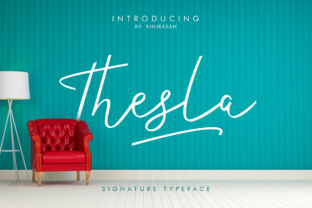
Thesla Script: A Handmade Thin Line Font for Refined Design Work
Script fonts occupy a distinct space in typography, often balancing personality with readability. Among them, Thesla Script stands out as a handmade, thin line font that brings a subtle, refined character to digital and print projects. Unlike many script fonts that lean toward bold or ornate styles, Thesla Script offers a lighter touch—both in visual weight and in the impression it leaves on the viewer. This makes it a worthwhile option for designers, content creators, and business owners who need a typeface that feels personal without sacrificing professionalism.
What Thesla Script Is and Why It Deserves Attention
Thesla Script is a digital typeface designed with a thin, consistent stroke weight and a genuine hand-drawn quality. The term "handmade" here is not merely a marketing label; the font carries the subtle irregularities and organic flow that come from letterforms created by hand rather than generated purely by algorithm. Each character has a slight asymmetry and natural variation in spacing, which gives text a human, unpolished charm while still maintaining legibility.
What makes Thesla Script worth discussing is its ability to serve as a bridge between formal typography and casual handwriting. In a landscape where many script fonts either imitate digital cursive too perfectly or lean into exaggerated flourishes, Thesla Script finds a middle ground. It is clean enough for body text at moderate sizes, yet distinctive enough for headlines, logos, and accent typography. This dual utility is rare among thin line scripts, which often excel in one area but falter in another.
Key Characteristics and Design Philosophy
Examining Thesla Script at the glyph level reveals several deliberate choices. The thin line weight is consistent across uppercase, lowercase, numerals, and punctuation, creating a uniform rhythm that helps the font hold together in blocks of text. Ascenders and descenders are moderate, not exaggerated, which means the font does not require excessive leading to remain readable. The slant is gentle, typical of a connected script but not so steep that it competes with surrounding design elements.
The handmade quality is most evident in the subtle variations between identical characters. For example, the lowercase "a" and "e" may show slight differences in loop closure or curvature across repeated uses. This is not a flaw but a feature—it mimics the natural inconsistency of handwriting and reduces the mechanical feel that can plague script fonts. For designers who want text to feel personal and approachable, this characteristic is valuable.
Another notable aspect is the spacing. Thesla Script uses a relatively tight letterfit, with characters connecting smoothly without crowding. This is important for thin line fonts, where excessive spacing can make text appear disjointed, and insufficient spacing can cause letters to bleed into one another. The designer has clearly paid attention to kerning pairs, especially where letters like "r," "n," and "m" follow ascenders or descenders.
Practical Performance in Real-World Use
When evaluating a font for professional work, performance under different conditions matters. Thesla Script holds up well at sizes between 14pt and 36pt for display purposes, and can be used effectively as low as 10pt for short paragraphs, provided the background is solid and the contrast is high. At very small sizes, the thin line can become delicate, especially on lower-resolution screens, so it is best reserved for print or high-DPI digital displays when used for body text.
In terms of file format and technical reliability, Thesla Script is typically delivered as a standard OTF or TTF file with a complete character set including ligatures and alternate characters. The inclusion of ligatures is a practical advantage, as it ensures smooth connections between problematic letter pairs like "ff," "fi," and "fl." This attention to detail reduces the need for manual kerning adjustments in layout software.
For logo design and branding applications, the font performs admirably. Its thin, uniform weight works well for wordmarks that need to appear elegant and understated. It also pairs effectively with sans-serif typefaces for a balanced hierarchy. In practice, using Thesla Script for a headline with a clean sans-serif like Inter or Open Sans for body copy creates a contrast that is both visually pleasing and functional.
Who Benefits Most from Thesla Script
Identifying the right audience for Thesla Script is essential for practical recommendation. Based on its characteristics, several groups stand to gain the most from incorporating this font into their work.
- Small business owners and entrepreneurs who need a distinctive yet professional typeface for branding materials—business cards, stationery, packaging, and social media graphics. The handwritten quality conveys approachability, while the thin line suggests attention to detail and sophistication.
- Freelance designers and creative professionals looking for a reliable script option that does not dominate a layout. Thesla Script can be used for client projects ranging from wedding invitations to editorial design, where a subtle, elegant script is required without overpowering other elements.
- Bloggers and content creators who want to add a personal touch to headings, pull quotes, or logo marks. The font works well on personal brand websites, especially when paired with a clean sans-serif for readability.
- Educators and workshop facilitators creating materials that need a warm, human feel—worksheets, course guides, or presentation slides. The thin line keeps the text legible while the handmade quality softens the formal tone.
- Marketers and publishers who need a consistent script for campaign materials, email headers, or print advertisements. The font's uniformity across weights and styles ensures that brand messaging remains coherent across different media.
Strengths That Add Practical Value
Thesla Script offers several concrete strengths that translate directly into useful outcomes for professionals.
Readability at moderate sizes is a clear advantage. Many thin line scripts sacrifice legibility for style, but Thesla Script maintains clear distinctions between letters. The open counters in letters like "e," "a," and "o" prevent them from closing up, even at smaller sizes. This means the font can be used for short form body text without causing reader fatigue.
Versatility across mediums is another strength. The font looks equally good on coated and uncoated paper, on screen and in print. Its thin weight adapts well to foil stamping or embossing, where thicker fonts might lose detail. For digital use, the font retains its character on retina displays and works well in SVG or web font formats when properly hinted.
Consistency in character design deserves mention. While the font is handmade, it does not suffer from erratic stroke width or uneven slant. Each letter sits on a consistent baseline, and the connecting strokes are uniform in thickness. This reliability is crucial for professional projects where multiple instances of the same letter appear close together, as in logos or headlines.
Realistic Limitations to Consider
No font is without constraints, and Thesla Script is no exception. Being transparent about these limitations helps professionals make informed decisions.
- Limited bold and italic variants. Thesla Script is primarily available in a single weight. If you need a bold counterpart for emphasis or hierarchy, you will need to pair it with another typeface. This is manageable for most projects but requires deliberate planning.
- Performance at very small sizes. Below 9pt on standard resolution screens, the thin lines can become difficult to read. For body text in web design, it is better to use the font for headings and accents rather than full paragraphs.
- Not suitable for dense or long-form text. The connected script style and thin weight make it less ideal for extended reading. Readers may experience eye strain if faced with large blocks of Thesla Script. Reserve it for short passages, labels, titles, and signature-style applications.
- Handmade irregularities may not suit all brands. Some businesses require a perfectly uniform, modern aesthetic. In those contexts, a geometric sans-serif or a more rigid script would be more appropriate. Thesla Script works best for brands that want to communicate warmth, creativity, or craftsmanship.
Practical Recommendations for Getting the Most Out of Thesla Script
For those who decide to integrate Thesla Script into their work, a few considerations can improve the outcome. First, pair it with a neutral sans-serif that has moderate x-height and clean lines. Fonts like Work Sans, Source Sans Pro, or Karla allow the script to stand out without clashing. For a more formal pairing, a serif with thin strokes, such as Playfair Display or Cormorant Garamond, can create a cohesive, elegant look.
Second, pay attention to spacing. Thesla Script's tight letterfit means that adding a small amount of letter-spacing (2–5 points) can improve readability in headings, while reducing it further can create a more connected, signature-like appearance. Experiment with tracking settings in your design software to find the sweet spot for your specific use case.
Third, test the font at the actual sizes and mediums you intend to use. A logo that looks perfect on screen at 72pt may behave differently on a business card at 10pt or on a large-format poster. Print a sample, view it on different devices, and adjust accordingly. This step is especially important with thin line fonts, where contrast and background color significantly affect legibility.
Fourth, consider using ligatures and alternate characters to enhance the handmade feel. Many script fonts include stylistic alternates for beginning, middle, and end of words. Using these thoughtfully can make text appear more natural and less repetitive, which is particularly beneficial for short phrases and single-word logos.
Long-Term Value and Suitability Across Projects
Assessing whether Thesla Script offers lasting value depends on how it fits into a broader design system. For professionals who work on diverse projects—branding, editorial, web, packaging—having a reliable script that can serve multiple roles is a practical advantage. Thesla Script's neutral yet warm character means it does not quickly feel dated, which is a risk with highly stylized fonts. Its handmade quality, while distinctive, is not so extreme that it will look out of place in a few years.
For entrepreneurs and small business owners, the font can function as a core brand asset if the brand identity leans toward artisanal, personal, or creative. For designers, it is a useful addition to a font library that already includes workhorse sans-serifs and serifs. It fills the gap between overly formal scripts and casual handwriting fonts, offering a reliable option when a client needs something that feels personal but still professional.
In terms of file maintenance and compatibility, the standard formats ensure that Thesla Script will work across major design applications—Adobe Creative Suite, Figma, Sketch, Affinity, and common word processors. No special software or plugins are required, which reduces setup time and technical friction.
Ultimately, the decision to use Thesla Script should be based on the specific demands of your project. If the goal is to communicate warmth, elegance, and a human touch without sacrificing legibility or professionalism, this font is a strong candidate. It is not a universal solution—no single font is—but within its range of appropriate applications, it performs with consistency and character.
By understanding its strengths, respecting its limitations, and applying it in contexts that suit its personality, professionals can leverage Thesla Script to enhance their work in ways that feel intentional, not decorative. That practical, grounded utility is what makes a font worth revisiting project after project.