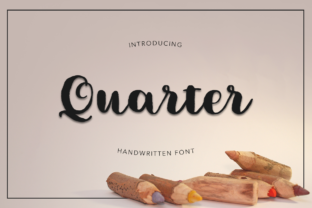
Quarter: A Handwritten Font That Feels Human
There is a quiet shift happening in the way we communicate visually. Screens are getting cleaner, interfaces are getting simpler, and yet, something is often missing. That something is the warmth of a human hand. In a world of perfectly aligned sans-serifs and geometric precision, Quarter enters as a handwritten font that brings a different kind of energy. It is neither overly ornate nor coldly mechanical. It is a script that feels personal without sacrificing readability, and that balance makes it a surprisingly versatile tool for anyone working on projects that need to feel approachable.
If you have ever tried to make a flyer, a social media graphic, or even a simple presentation feel less corporate, you know the struggle. The default fonts feel stiff. The decorative ones feel gimmicky. Quarter sits somewhere in between. It is a handwritten font, yes, but one that has been crafted to remain clear at different sizes and across different mediums. This is not a font that forces you to squint or decode each letter. It flows naturally, and that simplicity opens up a wide range of real-world applications.
When a Brand Needs to Feel Like a Person
Branding is often discussed in terms of logos and color palettes, but the typeface a brand uses carries as much weight as any visual element. Quarter works particularly well for brands that want to communicate trust without formality. Imagine a small coffee shop that wants its menu board to feel handwritten without actually being hand-written. The font gives that impression of a friendly note left for a regular customer. It feels intentional but not overly designed.
For freelancers and solopreneurs, Quarter can be a subtle way to signal that there is a real person behind the business. A wedding photographer, for instance, might use it on their website headers or in their print materials. It suggests care and attention to detail. A nutrition coach or a yoga instructor might use it in email headers or welcome packets. The font does not scream "handmade," but it does whisper "I put thought into this." That distinction matters when you are trying to build a connection with an audience that is tired of overly polished marketing.
There is also something to be said about the way Quarter handles in smaller spaces. Because the letterforms remain open and legible, it works well on business cards, product tags, or even short-form content like pull quotes in a blog post. When a brand uses Quarter on physical materials, it gives the impression that the brand cares about the tactile experience, not just the digital one.
Personal Projects That Deserve More Than a Default Font
Not everything needs to be about business. A lot of the people downloading and using Quarter are doing so for deeply personal reasons. Think about invitations, for example. Wedding invitations, birthday party announcements, or even simple "thank you" notes can feel cold when set in a standard font. Quarter adds a layer of intimacy without requiring calligraphy skills.
If you are designing a photo album for a family trip or a milestone like a graduation, using Quarter for titles and captions can make the whole project feel cohesive and emotional. It is not trying to imitate handwriting in a nostalgic way, but it does evoke that same sense of memory and care. The font moves well across spreads, and it reads easily even when overlaid on photos with lighter backgrounds.
Another area where Quarter shines is in journaling or self-publishing. Whether you are putting together a zine about your gardening experiments or creating a small poetry chapbook, the font gives the text a handmade quality. It does not look like it was mass-produced. It looks like someone sat down and wrote it, which is exactly the feeling many creators are chasing.
Social Media and Digital Content That Stops the Scroll
Social media feeds are crowded, and attention spans are short. One way to make content stand out is to use typography that feels different from the rest. Quarter works well for Instagram stories, quote graphics, and short video titles. Its handwritten quality catches the eye because it breaks the visual rhythm of perfectly aligned text.
For content creators who do not want to rely on the same aesthetic as everyone else, Quarter offers a distinctive but not distracting option. It pairs well with clean sans-serif fonts, so you can create contrast without clashing. A typical use might be a large Quarter headline over a simple background, followed by body text in a neutral typeface. That combo feels editorial but also personal.
It is also worth noting that Quarter handles well at larger sizes. The curves and strokes become more apparent, and the personality of the font really comes through. This makes it a strong choice for YouTube thumbnail text, workshop promotional graphics, or even newsletter headers. The font does not lose its charm when scaled up, which is a problem with many handwritten fonts that were designed primarily for small sizes.
Print Materials That Need a Warm Tone
Physical materials still matter, and they are often where handwritten fonts make the biggest impact. Flyers, posters, and signage that use Quarter feel more approachable. A community center advertising a local event would benefit from the font because it signals openness and informality. A yoga studio promoting a workshop could use it to create a sense of calm and invitation.
Quarter is also practical for packaging. Small product lines, especially those focused on natural or artisanal goods, can use the font to reinforce their brand story. Soap labels, candle jars, tea packaging, or skincare containers often rely on typography to communicate their values. A handwritten font suggests that the product was made with care, not just churned out in a factory. Quarter achieves that without being difficult to read at small sizes, which is a common limitation in this category.
Another practical use is in educational materials. Teachers, tutors, or course creators who want their worksheets, handouts, or class notes to feel more personal can use Quarter for headers or key points. It is legible enough for children and adults alike, and it softens the often clinical look of printed educational content.
Considerations Before You Start Using Quarter
No font is perfect for every situation, and being honest about limitations makes your work better. Quarter is a handwritten script, so it works best when used for short to medium-length text. Long paragraphs set entirely in Quarter can become tiring to read, even if the letterforms are clear. The font is designed to feel personal, not to carry dense information. Use it for headlines, subheadings, short blocks of text, or accent pieces. Let a clean sans-serif or serif font handle the heavy lifting in body copy.
Another point to consider is context. Quarter has a friendly, approachable tone. It would not be the right choice for a legal document, a financial report, or any situation that requires a strictly formal appearance. It also leans slightly casual, so if your project demands a professional or authoritative voice, you may want to use Quarter sparingly or as a secondary typeface.
Pairing is also important. Quarter works beautifully with minimalist fonts like Helvetica, Arial, or any clean geometric sans-serif. Avoid pairing it with other decorative or handwritten fonts, as that can quickly become chaotic. The goal is contrast, not competition. One voice should dominate, and in this case, Quarter should be the accent that adds warmth to a more neutral foundation.
Finally, test the font at the sizes and mediums you plan to use. What looks charming on a screen might feel different in print, and vice versa. Most handwritten fonts vary in weight and spacing, and Quarter is no exception. Run a few test layouts before committing, especially if you are working on a project that involves production costs like printing or packaging.
Who Benefits Most from Quarter
Small business owners, creative freelancers, event planners, and content creators are probably the most obvious audience for Quarter, but the font also has appeal for educators, non-profit organizers, and hobbyists. Anyone who wants to add a human touch to their communication without losing clarity will find something useful in this font.
For designers, Quarter offers a reliable shortcut to warmth. You do not need to spend hours customizing letterforms or searching for the perfect handwritten alternative. It is ready to use and consistent across different applications. For non-designers, the font is forgiving. It does not require expert typography skills to look good. You can drop it into a project and it will immediately shift the tone in a positive direction.
There is also a growing audience of people who are creating content for smaller communities, like local newsletters, church bulletins, or club announcements. Quarter fits naturally into those contexts because it does not feel corporate. It feels like someone made an effort, which is exactly the impression you want when communicating with a tight-knit group.
Final Thoughts on Working with Quarter
Quarter is not trying to be the most expressive or the most minimal handwritten font available. It is trying to be useful, and that is a rare quality in typography. It sits comfortably between personality and practicality, which is exactly where most real-world projects need to be. Whether you are branding a small business, creating a personal keepsake, or designing content for a digital audience, Quarter gives you a way to communicate with warmth without sacrificing readability. It is a font that lets your message feel human, and in a landscape full of automated and templated content, that is a genuine advantage.