Hieronymus Formenschneider: The Man Who Gave Fraktur to the World
If you have ever admired the sharp, broken strokes of a classic German blackletter typeface, you have Hieronymus Andreae to thank. Better known in his later years as Hieronymus Formenschneider — a surname he adopted like a badge of honor — this Nuremberg craftsman didn't just cut woodblocks for a living. He changed the course of typography by introducing Fraktur script to the world of print, working directly under the orders of Emperor Maximilian I and alongside none other than Albrecht Dürer. This is not a story about an obscure historical footnote. This is the origin story of one of the most influential display fonts in European design history.
Who Was Hieronymus Andreae and Why Does His Work Still Matter?
Andreae began his career as a woodblock cutter, a hands-on craft that demanded precision, patience, and an eye for detail. In the early 1500s, woodblock cutting was the backbone of print illustration and ornamentation. But Andreae was not content to simply execute other people's designs. He had a vision for a new kind of type — one that could capture the elegance and authority of manuscript culture while bringing it into the age of movable type.
That vision became Fraktur, a script that broke away from the rounder, softer forms of earlier blackletter styles. Where Textura was dense and blocky, Fraktur was sharp, angular, and surprisingly readable at larger sizes. Emperor Maximilian I, a passionate patron of the arts and an astute propagandist, saw the potential immediately. He commissioned Andreae to develop this new script for official imperial publications. And in a joint venture with Albrecht Dürer — who designed the illustrations — Fraktur made its first major public appearance in works that still stand as landmarks of Renaissance print design.
Later in life, Andreae turned to music publishing. His magnum opus in this field was the Coralis Constantini by Heinrich Isaac, a monumental collection of liturgical music that required both musical notation and text in Fraktur. This project cemented his reputation as a publisher in Nuremberg, where he continued working until his death in 1565. But his legacy as Formenschneider — literally "form cutter" — outlived him. He didn't just cut forms; he defined a visual language that would dominate German printing for nearly 400 years.
Visual Characteristics: What Makes Fraktur Stand Out as a Display Font
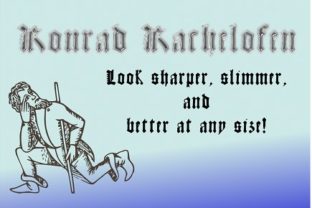
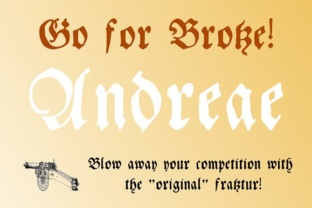
Fraktur is not a subtle typeface. It commands attention. Its visual personality is rooted in contrast: thick vertical strokes meet razor-sharp diagonal breaks, creating a texture that feels both medieval and surprisingly modern. The lowercase letters often feature distinctive "broken" curves — what typographers call gebrochene Schrift — and the capitals are elaborate, often ornamental, without sacrificing legibility at display sizes.
If you are evaluating Fraktur for a contemporary project, here is what you need to know about its visual DNA:
- High stroke contrast — The difference between thick and thin strokes is dramatic, giving the typeface a structured, architectural feel.
- Ascenders and descenders — These are pronounced, which means Fraktur takes up vertical space. It is not a space-saving font, and it should not be used for dense body copy in small sizes.
- Angular terminals — Many letterforms end in sharp points or diagonal cuts, creating a rhythmic, almost calligraphic flow.
- Ornamental capitals — The uppercase letters often include flourishes that make them ideal for drop caps, headings, and logo design.
- Historical weight — The typeface carries cultural connotations. In European contexts, it evokes tradition, authority, and craftsmanship. In global contexts, it can signal heritage, authenticity, or even rebellion depending on usage.
Fraktur is fundamentally a serif font, but it belongs to a subcategory that designers call blackletter or gothic. Its personality is formal, historical, and commanding. It is not friendly or casual. It is not minimal. It is a typeface that says, "Pay attention."
Where Fraktur Works Best Across Creative and Commercial Projects
Because Fraktur is so visually distinctive, it works best as a display font — meaning it is designed for larger sizes where its details can shine. This is not a font for 12-point body paragraphs. But in the right context, it is transformative.
Brand identity and logo design
If your brand is rooted in tradition, heritage, or craftsmanship, Fraktur can give you instant historical authority. Think breweries, distilleries, law firms with deep roots, heritage publishers, or luxury goods that emphasize artisanal quality. The key is to use it sparingly — a wordmark or a single headline — and pair it with a clean, neutral sans serif font for body text. This contrast between old and new is visually striking and communicates both respect for tradition and modern professionalism.
Editorial and packaging design
Fraktur shines on book covers, especially for historical fiction, poetry collections, or academic works. In packaging design, it works well for premium food products, wine labels, and specialty spirits. The angular forms catch light and create texture, making them ideal for foil stamping or embossing. If you are designing for a client who wants to signal "artisanal" without using the word, Fraktur does the heavy lifting.
Social media graphics and web design
On digital platforms, Fraktur is less common — which is exactly why it stands out. Use it for hero headings, event posters, or limited-edition announcements. Because it is less readable than modern sans serifs, use it for short, impactful phrases. A single word in Fraktur on a clean background can be more memorable than a paragraph in Arial. Just be mindful that web fonts can render differently across browsers, so test your pairings thoroughly before going live.
Music and event publishing
Given Andreae's work on the Coralis Constantini, it is fitting that Fraktur remains a natural choice for concert programs, festival branding, and music publications — especially classical, choral, or early music events. The typeface carries the visual weight of tradition without needing any additional ornamentation.
How Fraktur Influences Readability, Hierarchy, and Brand Perception
Readability is not just about legibility — it is about how a reader feels when they engage with your content. Fraktur, used well, changes the emotional tone of a design instantly. It communicates that what you are reading has history. It signals that care was taken. It suggests that the content is worth slowing down for.
In terms of visual hierarchy, Fraktur creates an immediate anchor. Because it is so different from typical serif or sans serif fonts, a headline set in Fraktur naturally sits at the top of the visual hierarchy. You can use this to guide the reader's eye: Fraktur for the main message, a clean sans serif for subheadings, and a neutral serif or sans for body copy. The contrast alone creates structure without needing additional graphic elements.
Brand perception is where Fraktur truly earns its keep. A brand that uses Fraktur thoughtfully is perceived as established, confident, and detail-oriented. But there is a caveat: Fraktur carries historical baggage in some contexts. In German-speaking countries, its association with Nazi-era propaganda means it must be used with cultural sensitivity. In other regions, it is simply seen as "old German," which can be either an asset or a liability depending on your audience. Always consider the cultural context before committing to Fraktur as a primary brand typeface.
Practical Guidance: Choosing Fraktur and Making It Work
If you are considering Fraktur for a project, start by asking yourself whether the font's personality aligns with your brand's story. Fraktur is not a neutral tool — it is a statement. Here is a practical checklist to guide your decision:
- Evaluate project fit. Is your project rooted in tradition, history, or craftsmanship? Does it need to communicate authority? If yes, Fraktur is a strong candidate. If your brand is focused on innovation, speed, or accessibility, look elsewhere.
- Test font pairings. Fraktur pairs best with simple, neutral sans serif fonts like Helvetica Now, Univers, or Inter. Avoid pairing it with other decorative or script fonts — the result will be visually noisy. A common formula: Fraktur headline + sans serif subhead + serif body. This gives you contrast and readability in one system.
- Review included styles. Many digital Fraktur fonts come in multiple weights — light, regular, bold, and sometimes black. A typical Fraktur family is smaller than modern sans serif families, so check what you get. If your project requires extensive body copy in Fraktur, you may need to purchase a version specifically designed for that purpose. For most display use, one or two weights are sufficient.
- Readability considerations. Never set long paragraphs in Fraktur at body sizes. It will fatigue readers and reduce comprehension. Use it for headlines, pull quotes, drop caps, and short emphasis phrases. For body copy, choose a complementary serif or sans serif that is optimized for extended reading.
- Commercial licensing. If you are using Fraktur for commercial projects — including logos, packaging, merchandise, or client work — ensure you purchase a commercial font license. Many digital versions of Fraktur are available from reputable foundries like Linotype, MyFonts, or FontShop. Check the license terms carefully. Some "free" versions are only for personal use or have restrictions on embedding in web projects. Paying for a proper license supports the designers and gives you legal peace of mind.
Andreae's Legacy and What It Means for Modern Designers
Hieronymus Formenschneider did not just cut woodblocks. He cut a path for an entire typographic tradition. Fraktur may not be the right choice for every project — and it certainly should not be used carelessly — but when it fits, it fits powerfully. It connects your work to a lineage of craftsmanship that stretches back five centuries. That is not nostalgia. That is good design judgment.
Whether you are a publisher laying out a poetry collection, a marketer building a whiskey brand, or a designer experimenting with social media graphics, Fraktur offers a visual vocabulary that is immediately recognizable and emotionally resonant. Use it with intention, pair it with restraint, and you will create work that feels both historic and entirely of the moment.
Because sometimes the most modern thing you can do is draw from the very old. Andreae understood that. Now you can too.