The Bosk Brush Font: Why Handmade Type Still Matters in a Digital World
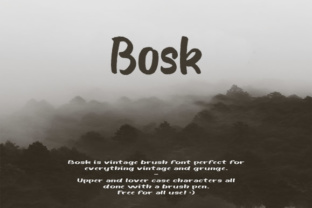
Typography has a way of shaping how we perceive a message before we even read a single word. In an era where design tools churn out perfectly uniform vectors in milliseconds, there is something refreshingly intentional about a typeface that carries the marks of human touch. Bosk, and more specifically The Bosk Brush font, is one of those rare finds. It is a vintage handmade font created using a brush pen, and it brings an unmistakable warmth and authenticity to any project.
But what exactly makes a brush-pen font stand out from the thousands of digital typefaces available today? And more importantly, is Bosk the right choice for your next design project? Let's break down the qualities, practical applications, and real-world considerations of working with this distinctive handmade typeface.
The Origin Story Behind Bosk
Every font has a story, and Bosk's begins with a physical brush pen moving across paper. Unlike fonts that are conceived entirely on screen, Bosk was first drawn by hand, stroke by stroke. The irregularities you see in each character are not errors or imperfections. They are intentional artifacts of a human hand at work.
When a designer picks up a brush pen, the pressure, angle, speed, and even the ink flow all contribute to the final shape of each letter. Bosk captures those real-world variables and translates them into a digital format that retains the feel of its analog origins. The result is a font that does not look like it was extruded from a machine. Instead, it looks like someone sat down and wrote it just for you.
This handmade origin is central to what makes Bosk appealing. It is a font that carries the memory of its creation, and that memory becomes part of the message it delivers.
Key Qualities of the Bosk Brush Font
To understand where Bosk fits best, it helps to look at the specific characteristics that define it. These are not the flashy, attention-grabbing features you might find in a display font. Rather, they are subtle qualities that add depth and texture to any design.
Brush Pen Texture and Flow
The most immediate thing you notice about Bosk is the texture. Because it was drawn with a brush pen, each letter has a natural variation in stroke width. Some lines are thick and bold where the brush pressed harder. Others are thinner and lighter where the pen lifted slightly. This variation gives the font a rhythmic, almost musical quality when set as a block of text or a short phrase.
Unlike vector fonts that rely on mathematically perfect curves, Bosk has edges that feel soft and organic. The ink bleeds just enough at certain points to remind you that this typeface was once wet on paper. It is this texture that separates a truly handmade font from one that merely tries to look handmade.
Vintage Character with Modern Readability
There is a common assumption that vintage fonts are difficult to read. While some display faces do lean heavily into ornamentation, Bosk strikes a careful balance. The letterforms are clearly recognizable, and the spacing is thoughtful. You get the nostalgic feel of a mid-century sign or a hand-lettered poster without sacrificing legibility.
This makes Bosk versatile in ways that many other handmade fonts are not. You can use it for a headline and still expect your audience to read it without squinting. That combination of vintage charm and readability is harder to find than you might think.
Consistency Without Uniformity
One of the biggest challenges in creating a handmade font is maintaining consistency across all characters. If every letter behaves differently, the font becomes chaotic. If every letter is too uniform, it loses the handmade feel. Bosk manages to walk this line well. There is a consistent voice throughout the character set, but no two letters feel identical. The lowercase "a" and "e" carry the same brush energy, yet each has its own subtle quirks. This gives the font personality without descending into disorder.
Where Bosk Fits in Modern Workflows
Handmade fonts are no longer limited to niche craft projects. Designers across industries are incorporating them into branding, editorial, packaging, and digital interfaces. Bosk is particularly well suited for scenarios where you want to communicate warmth, authenticity, or a personal touch.
Branding and Logo Work
For small businesses, artisans, freelancers, and creative agencies, Bosk offers a way to differentiate from corporate competitors. If you are branding a coffee shop, a bakery, a woodworker, or a boutique design studio, this font can serve as a visual anchor that communicates craftsmanship. It tells potential customers that your brand values the human element. It says you are not mass-produced.
When used in a logo, Bosk pair well with simpler sans-serif fonts for secondary text. The contrast between a rugged brush-pen logotype and a clean modern subtext creates visual interest and hierarchy. Many designers recommend keeping the supporting typefaces minimal to let Bosk carry the personality.
Packaging and Product Design
Product packaging is one of those spaces where every detail matters. A font like Bosk can make a product feel artisanal, handcrafted, or small-batch even if it is produced at scale. Think of a label on a bottle of small-batch hot sauce, a box of handmade chocolates, or a bag of single-origin coffee. The font itself communicates a story about how the product was made.
In e-commerce, where customers cannot physically touch the product, the typography on packaging often serves as a proxy for quality. Bosk helps bridge that gap by adding tactile warmth to product imagery.
Editorial and Web Design
Blog headers, magazine titles, and hero section headings are natural homes for Bosk. Because the font carries so much personality, it works best when used sparingly. A full article set in Bosk would likely overwhelm the reader, but a well-placed heading or pull quote can anchor the page and set the tone for the content below.
On the web, it is important to consider loading times and rendering. Bosk is a standard font file, so it performs well across modern browsers. Pair it with a legible body font like a clean serif or a neutral sans-serif, and you create a layout that feels curated rather than chaotic.
Practical Benefits of Choosing a Handmade Font
There are plenty of reasons to choose a font like Bosk beyond just aesthetics. The practical benefits often reveal themselves during the design process itself.
Standing Out in a Saturated Visual Landscape
Users today are exposed to thousands of visual messages every day. Most of those messages use default system fonts or generic typefaces that blend into the background. A handmade font interrupts that pattern. It stops the eye. It makes the reader pause, even if only for a fraction of a second. That pause is valuable real estate in design.
Bosk, with its brush-pen origins, achieves this without being loud or aggressive. It is distinctive but not distracting. It invites engagement rather than demanding it.
Conveying Emotion Without Extra Imagery
Sometimes you do not have the budget or space for elaborate illustrations or photography. In those cases, the typography itself must carry the emotional weight. Bosk can do that. A single word set in this font can evoke nostalgia, comfort, creativity, or sincerity. The brush strokes carry a human energy that photographs or icons sometimes cannot match.
For social media graphics, email headers, or simple landing pages, this is a massive advantage. You get emotional resonance without needing a full art direction.
Flexibility Across Print and Digital
Because Bosk was created from physical brush strokes, it retains its character in both print and digital environments. On paper, the texture feels natural and grounded. On screen, it brings a softness that contrasts well with the sharp pixels of modern displays. The font does not require heavy tweaking to look good in either medium, which saves time during production.
Considerations Before Using Bosk
No font is a one-size-fits-all solution. Bosk has specific strengths, but it also has limitations that designers should consider before committing to it for a project.
Not Ideal for Long Body Text
Bosk shines in short-form contexts. Headlines, logos, labels, quotes, and short paragraphs are where it performs best. For long body text, paragraphs, or articles, the brush-pen texture can become fatiguing to read. The irregularities that make it charming in small doses can feel disruptive at length. If you are designing a book or a lengthy report, reserve Bosk for chapter headers or pull quotes and use a more neutral font for the main text.
Pairing with Complementary Fonts
Because Bosk has such a strong personality, it needs a partner that can support rather than compete with it. Sans-serif fonts with clean geometric shapes tend to work well. Fonts like Montserrat, Open Sans, or even a classic Helvetica can provide the contrast that allows Bosk to stand out without clashing. Avoid pairing Bosk with another highly decorative font unless you are intentionally going for a maximalist look.
Licensing and Usage Rights
As with any commercial font, it is important to check the licensing terms for Bosk before using it in client work or commercial products. Some handmade fonts have restrictions on embedding in apps, using in logo trademarks, or including in template files. Always confirm that your intended use falls within the license agreement to avoid complications down the road.
Real-World Examples and Scenarios
Picture a local coffee roaster designing their first packaging line. They want the bags to feel personal, like each one was handled with care. A clean sans-serif font would look professional, but it might feel cold. Bosk, used for the roast name and origin details, adds the handmade texture that aligns with the brand story. The bag feels like it belongs in a farmer's market, not a big-box store.
Or consider a wedding invitation suite. The couple wants something romantic and timeless but not overly ornate. Bosk on the main names, paired with a light elegant serif for details, gives the invitation a hand-lettered feel without the cost of commissioning custom calligraphy. It feels personal, yet it is reproducible.
In the world of content creation, a YouTuber or podcaster might use Bosk for episode titles and channel branding. The font helps communicate that the content is original, not produced by a corporate media machine. It signals authenticity at a glance.
Final Observations on Bosk and Handmade Typography
The Bosk Brush font is more than a set of characters. It is a design tool that carries the energy of its creation into every project it touches. In a design landscape that sometimes leans too hard into polish and perfection, Bosk offers a welcome return to the tactile, the human, and the real. It reminds us that not everything needs to look like it came off an assembly line.
Whether you are building a brand from scratch, refreshing a product line, or simply looking for a font that adds warmth to your next project, Bosk deserves a serious look. Test it in your layouts. Pair it with something clean and quiet. See how it changes the tone of your message. You might find that a little bit of brush-pen imperfection is exactly what your design needed all along.