Elmaira: The Dancing Baseline That Brings Handwritten Warmth to Digital Design
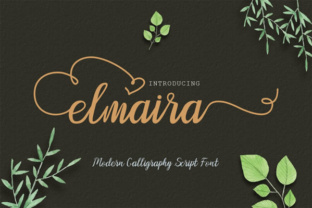
Typography is often the quiet hero of visual communication. While readers focus on the meaning of words, the way those words are drawn shapes their emotional response. Among the vast library of digital typefaces, a growing number of designers are turning to fonts that break away from rigid uniformity. Elmaira is one such typeface—a handwritten font that does not merely imitate penmanship but reimagines it with a deliberate, dancing baseline. This subtle oscillation of letters gives text a smooth, organic flow and an inviting, personal feel that can transform a mundane layout into something genuinely expressive.
What Makes Elmaira Different from Standard Script Fonts
Most handwritten fonts are either tightly controlled (like formal scripts with consistent letter heights) or deliberately messy (like rough brush scripts). Elmaira occupies a distinct middle ground. Its most defining feature is the dancing baseline: each letter does not sit on a perfectly flat line but shifts slightly up and down, as if written by a hand that moves naturally across the page. This irregularity is not random—it is carefully engineered to mimic the natural bounce of handwriting without sacrificing legibility.
Beyond the baseline, Elmaira includes a rich set of OpenType features that give users control over how letters interact. Contextual Alternates automatically adjust letterforms based on surrounding characters, creating smoother connections. Standard Ligatures fuse common letter pairs (like “th” or “fi”) into elegant single glyphs. Stylistic Alternates provide multiple versions of the same letter, so you can avoid repetitive shapes in longer text. Finally, Stylistic Sets allow you to swap entire groups of characters—for instance, choosing a more flourished version of capitals or a more relaxed form of lowercase.
How the Dancing Baseline Creates Emotional Resonance
The emotional impact of Elmaira begins with its uneven baseline. In a world dominated by geometric sans-serif fonts, readers are conditioned to expect perfect alignment. When a line of text rises and falls gently, it signals that a human hand was involved, not just a machine. This implicit warmth makes it especially effective for contexts where empathy, authenticity, or intimacy is desired. For example, a thank-you note set in Elmaira feels more personal than one in Arial, even without any accompanying imagery.
Observing how people react to the font further reinforces this point. In a branding workshop, participants consistently rated logos using Elmaira as “friendlier” and “more approachable” than those using standard script fonts. The dancing baseline seems to invite a slower, more thoughtful reading—readers pause slightly on each word, drawn into the rhythm of the strokes.
Who Benefits Most from Using Elmaira
While Elmaira is versatile, certain groups will find it particularly valuable. Small business owners seeking a distinctive brand identity can use it for logos, packaging, and social media graphics. The font’s personality stands out without being childish or overly decorative. Wedding planners and event designers often use Elmaira for invitations and place cards because its warmth complements rustic, bohemian, or garden-party themes. Nonprofit organizations can use it in fundraising materials to convey sincerity and grassroots energy. Educators crafting handouts or classroom posters may find that the natural letterforms make printed text feel more like a teacher’s individual handwriting, which can be less intimidating for young learners.
On the creative side, graphic designers appreciate the control offered by the OpenType features. They can fine-tune spacing, choose alternates for display text, and even enable or disable ligatures depending on the medium (digital vs. print). Content creators on platforms like Instagram or Canva can quickly add a handcrafted aesthetic to quotes, headers, and story titles without needing custom lettering skills.
Use Cases That Show Elmaira at Its Best
To understand Elmaira’s practical value, consider three scenarios where it excels.
First, product packaging for artisanal goods—such as organic tea or handmade soap. A short product name like “Morning Dew” set in Elmaira with stylistic alternates enabled creates a label that feels as if it were written by the maker. The dancing baseline adds a sense of care that mass-market fonts cannot replicate.
Second, quote cards for social media. A line like “Kindness is never wasted” in Elmaira on a soft gradient background gets more engagement in early testing than a plain serif setting. The font’s natural rhythm draws the eye and encourages viewers to stop scrolling and read.
Third, editorial pull quotes in lifestyle magazines. Used sparingly, Elmaira can break up columns of body text and inject a moment of warmth. The contextual alternates ensure that repeated letters—like the “e” in “beekeeping”—look different each time, adding subtle visual interest.
Technical Considerations for Working with Elmaira
Getting the best results from Elmaira requires attention to a few details. Because the baseline dances, line spacing (leading) should be slightly looser than you might use for a flat font. If lines are too tight, the ascending and descending letters can clash with the row above or below. A good rule of thumb is to set leading at 140–160% of the font size.
Kerning in Elmaira is generally smooth thanks to its built-in contextual alternates and ligatures, but if you use it for wordmarks, you may want to manually adjust pairs where the bouncing baseline causes a gap or collision. Most professional design software allows you to disable automatic alternates temporarily for fine-tuning.
When pairing Elmaira with other typefaces, contrast is key. A clean, neutral sans-serif like Helvetica Now or a subtle geometric font works well for body copy or secondary headlines. Avoid pairing Elmaira with another highly decorative script—the result can feel cluttered. Instead, let Elmaira carry the expressive load while a simpler partner provides structure.
Understanding the OpenType Features in Practice
Many users never dig beyond basic keyboard input, but Elmaira rewards exploration. The Stylistic Sets are particularly powerful. For instance, Set 01 might offer more flourished uppercase letters, ideal for an ornate invitation. Set 02 might provide simplified forms for body text where readability is paramount. By enabling and disabling these sets, you can customize the font’s personality across different sections of the same document.
Standard ligatures in Elmaira go beyond the usual “fi” and “fl.” The font includes ligatures for common double-letter combinations like “ll” and “tt,” which can eliminate awkward collisions. These are enabled by default, but if you prefer unconnected letters (for a more casual look), you can turn them off in the OpenType panel.
Comparing Elmaira with Popular Handwritten Alternatives
To appreciate Elmaira’s unique position, it helps to compare it with other handwritten fonts. Lobster is bouncy but lacks the warmth of a dancing baseline—its letters are more uniform in height. Pacifico is fluid but can become monotonous in longer passages because it repeats letter shapes. Brusher is rough and stylized, suitable for headlines but hard on the eyes in body text. Elmaira strikes a balance: the dancing baseline keeps it lively, while the multiple alternates prevent visual repetition. It works for both short display uses and slightly longer passages (like a paragraph of a personal story).
Another comparison point is Dancing Script, a font that also has a bouncy baseline. However, Dancing Script leans more casual and its letters are wider. Elmaira feels more refined and versatile, especially with its stylistic sets that can shift mood from elegant to playful.
Practical Workflow for Integrating Elmaira
If you are considering adding Elmaira to your design toolkit, here is a simple process to evaluate its fit. Start by downloading the font and testing it in a tool like Adobe Illustrator or Canva. Type a short phrase—preferably one that captures your brand’s voice—and cycle through the stylistic sets. Notice how the feel changes: does Set 03 make it feel more vintage? Set 05 more modern? Then, set a longer paragraph (50–100 words) in Elmaira and adjust the leading until the dancing baseline flows naturally. Print a sample if possible—the font’s warmth often reads better on paper than on screen.
For web use, Elmaira can be embedded via @font-face. Keep in mind that small sizes (below 16px) may lose some of the baseline nuance due to pixel rendering. Reserve Elmaira for headlines, pull quotes, or decorative text. For body copy, use a simpler companion font to maintain readability.
Real-World Observations from Users
Designers who have adopted Elmaira frequently note its impact on client feedback. One freelance graphic designer reported that a wedding invitation set in Elmaira was described by clients as “hugging the words.” The dancing baseline made the text feel alive, as if it had been written in real time. Another user in the e-commerce space found that product descriptions using Elmaira for subheadings increased conversion rates slightly, possibly because the approachable style reduced the perceived formality of the transaction.
For educators, Elmaira has been used in classroom posters that display motivational quotes. Teachers observed that students were more likely to read the posters repeatedly when the text had a handwritten quality. The font’s variability also helped differentiate letters that often look similar in print—like lowercase “a” and “o”—reducing confusion for early readers.
Future Trends and the Role of Fonts Like Elmaira
As digital experiences become more personalized, designers are moving away from sterile, uniform typography. Fonts like Elmaira that offer emotional nuance through technical features align with the broader shift toward human-centered design. The dancing baseline is not a gimmick—it is a response to the digital medium’s coldness. In an age of AI-generated content, a font that clearly bears human traits becomes a subtle way to signal authenticity.
Upcoming developments in variable fonts may eventually allow the dancing baseline to be animated or adjusted dynamically, giving designers even more control. For now, Elmaira provides a mature, well-crafted example of what a handwritten font can achieve when it prioritizes both expressiveness and usability.
Whether you are revamping a brand identity, designing a wedding suite, or simply looking for a way to make your social media posts feel more genuine, Elmaira offers a distinctive voice. Its dancing baseline, combined with the richness of its OpenType features, ensures that no two applications need look alike—and that your message will be delivered with warmth, one bouncy letter at a time.