Give You What You Like: A Handwritten Font That Fits Your Creative Projects
If you’ve been searching for a handwritten font that balances simplicity with personality, Give You What You Like is worth a close look. This isn’t a flashy, ornate script that demands center stage in every layout. Instead, it offers a natural, approachable feel that works across a surprising range of applications. Whether you’re designing a logo, laying out a social media graphic, or putting together a product label, this typeface brings a human touch without screaming for attention.
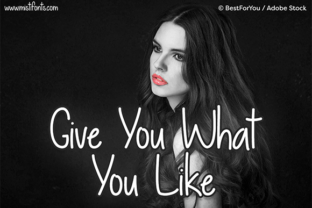
The letterforms in Give You What You Like carry a relaxed, slightly whimsical quality. Strokes are fluid but not overly cursive, making it readable at smaller sizes while still feeling hand-drawn. It sits comfortably in the category of modern handwritten fonts, but it avoids extremes—neither too messy nor too polished. That middle ground is where a lot of practical design work happens, and this font fills it well.
Where Give You What You Like Works Best
This font shines in projects where you want to communicate warmth or informality without losing professionalism. Small business owners often reach for handwritten fonts for branding, and Give You What You Like is a solid choice for that. It works well on logo design for boutiques, bakeries, or creative services, especially when paired with a clean sans serif for balance. The font’s natural curves add character without overwhelming the rest of your identity.
In marketing materials, think social media graphics, email headers, or promotional flyers. Because Give You What You Like is a display font by nature, it grabs attention in short bursts. It’s effective for pull quotes in editorial design or as a headline in blog posts where you want to emphasize a personal tone. For packaging design, such as candles or handmade goods, the font reinforces a crafted, artisanal feel.
Digital projects also benefit from this typeface. Use it sparingly on websites—perhaps for hero text or call-to-action buttons—to break away from standard serif font or sans serif font choices. In print, it handles brand identity pieces like business cards and stationery with a consistent, organic look. The key is to let it lead where personality matters most, then rely on cleaner modern typography for body copy.
How This Handwritten Font Boosts Brand Perception and Readability
Typography directly affects how an audience perceives your brand. Give You What You Like helps create a perception of approachability and authenticity. For entrepreneurs and marketers, this is valuable. When your audience sees a handwritten touch, they often associate it with smaller-scale, thoughtful businesses. The font supports that perception without looking amateurish, which is a common pitfall with free or poorly designed script fonts.
Readability is a practical concern with any handwritten font. Give You What You Like keeps letterforms distinct enough that you can use it at moderate sizes without confusion. It doesn’t rely on exaggerated ascenders or descenders that can break visual hierarchy. That means you can place it in subheadings or short paragraphs while maintaining clarity. For longer text, stick with a premium font in a more neutral style, but this font earns its place in short-form content.
Consistency matters in brand identity. Using Give You What You Like across multiple touchpoints—your website, product tags, Instagram posts—builds recognition. It’s a creative font that doesn’t demand constant reinvention. Once you establish it as part of your visual language, repeating it in different contexts reinforces your brand’s personality over time.
Practical Guidance for Choosing and Using Give You What You Like
Before you integrate this font into a project, evaluate fit. Start by asking: Does the tone of Give You What You Like align with my audience? For a law firm or financial service, probably not. But for a lifestyle blog, a wedding stationery shop, or a creative agency, it’s a natural match. Test it alongside your existing design assets to see if it complements or clashes. A quick mockup of a logo or social graphic can tell you more than staring at a font list.
Font pairing is where you can elevate the typeface. Give You What You Like pairs well with a clean sans serif font like Open Sans or Lato. The contrast between the organic script and the geometric sans creates a dynamic font pairing that feels modern and balanced. For a more editorial look, test it with a neutral serif font in body text. Avoid pairing it with another script or overly decorative type, as that risks visual clutter.
Review what’s included in the font package. Give You What You Like likely comes with standard uppercase and lowercase letters, numbers, and basic punctuation. Some versions include ligatures or alternate characters, which add to the hand-drawn feel. If you’re doing logo design, these extras can help customize the look without additional editing. Check the file format—OTF or TTF—and ensure it’s compatible with your design software.
Commercial licensing is a critical step. If you’re a small business owner or freelancer using the font for client work or product packaging, confirm that your license covers commercial use. Many premium font options require an extended license for broader distribution, like on merchandise or in apps. Read the terms carefully to avoid legal issues later. For personal projects or internal use, standard licenses usually suffice, but always verify.
Finally, test for readability at different sizes. Print out a sample at 24pt for headlines and 12pt for small text. See how Give You What You Like behaves in both. If you’re using it on a website, check how it renders on mobile screens. The font’s simplicity helps, but small adjustments in letter spacing or size might be necessary for optimal legibility.
When you get the pairing and sizing right, this font becomes a reliable tool in your creative kit. For a bakery’s Instagram stories, use it for the product name over a photo of pastries. For a craft supply shop’s packaging, let it carry the brand tagline. The font adds a layer of narrative that modern typography often lacks—a sense that someone actually wrote these letters by hand.