Esteban: A Brush Calligraphy Font Built for Spontaneous Expression
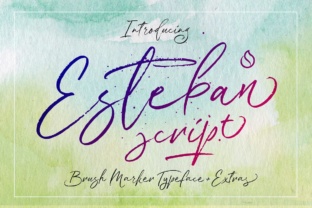
In the crowded field of display typefaces, it takes something genuinely distinctive to stand out. Esteban is one of those exceptions. Developed using a fine dry marker rather than a traditional brush or digital stylus, this font captures the energy of rapid, spontaneous lettering. The result is a playful personal script that avoids the polished uniformity of many calligraphy fonts in favor of something far more human.
What makes Esteban worth discussing is not just its unconventional creation method but the level of detail packed into every character. With more than 300 hand-drawn glyphs, a generous set of alternate characters, and carefully designed ligatures, it offers a level of versatility that many script fonts cannot match. For designers, marketers, and content creators looking for a typeface with personality and practical range, Esteban deserves a closer look.
The Design Story Behind Esteban
The decision to create Esteban using a fine dry marker rather than a traditional calligraphy brush or digital pen is not a trivial detail. It directly shapes the font's visual character. A dry marker produces uneven, textured strokes with subtle variations in weight and opacity. When applied quickly, as Esteban was, the result is a series of spontaneous gestures that feel immediate rather than labored. There is a looseness to the letterforms that is difficult to achieve with more controlled tools.
This spontaneity gives Esteban a distinctly playful energy. Letters do not conform to rigid geometric expectations. Instead, they lean, curve, and connect in ways that reflect natural hand movement. For projects where a stiff, mechanical look would be out of place, Esteban offers a refreshing alternative. The font does not try to hide its handmade origins. On the contrary, it celebrates them.
Over 300 Hand-Drawn Glyphs and What They Mean for Designers
One of the most practical strengths of Esteban is its glyph count. With more than 300 individually drawn characters, the font provides substantial coverage for a script typeface. This includes uppercase and lowercase letters, numerals, punctuation, and a large set of alternate characters and ligatures.
The alternates are particularly valuable. In many script fonts, repeated letters become visually monotonous. Esteban addresses this by offering multiple versions of frequently used characters. When combined with contextual ligatures, the font can produce text that reads as natural handwriting rather than a repeated pattern. For longer passages or headlines where a single word appears multiple times, this variety makes a noticeable difference.
The ligatures are not merely decorative. They are designed to improve the flow of letter combinations that typically look awkward in less refined scripts. Pairs such as "th," "er," "in," and "on" connect smoothly, maintaining the spontaneity that defines the font. For anyone using Esteban in real projects, these ligatures reduce the need for manual kerning and adjustment, saving time while improving visual consistency.
Strengths and Practical Value of Esteban
Esteban occupies a specific niche within the script font category. It is not a formal copperplate script, nor is it a casual handwritten scrawl. It sits somewhere in between, offering the structure of a designed typeface with the informality of marker-drawn lettering.
- Personality without sacrificing readability: Despite its spontaneous construction, Esteban remains legible at moderate sizes. This makes it suitable for headlines, subheadings, and short to medium-length text blocks where character is important.
- Extensive alternate character set: As noted, the alternates allow for customization and variation. This is especially useful for branding and logo work, where a unique look is often a priority.
- Natural ligature system: The built-in ligatures handle common letter pairings smoothly, contributing to a cohesive overall texture.
- Moderate weight and contrast: Esteban is not overly thin or thick. It works well on white backgrounds, colored surfaces, and even over images with careful placement.
Real-World Performance and Use Cases
In practice, Esteban performs best in contexts that value personality over neutrality. It is a poor choice for long body text, but that is not its intended purpose. Where it excels is in applications that require a human touch.
Branding and small business identity: Esteban can serve as a primary logotype font for brands that want to appear approachable, creative, or handcrafted. Coffee shops, boutique retailers, artisan product lines, and lifestyle blogs are natural fits. The alternate characters allow each logo to feel slightly unique, which is a clear advantage for branding work.
Social media graphics and digital content: On Instagram, Pinterest, or YouTube thumbnails, Esteban adds warmth and immediacy. It pairs well with clean sans-serif fonts for contrast. A typical layout might use Esteban for the headline and a neutral sans for supporting text, creating a balanced visual hierarchy.
Invitations, announcements, and printed ephemera: Wedding invitations, event flyers, greeting cards, and product packaging benefit from Esteban's hand-drawn quality. It reads as personal without being messy, which is a difficult balance to achieve.
Blog headers and section titles: For blogs and websites, Esteban works well as a display font for headings. It draws attention without overwhelming the page. When paired with a clean body font, it adds character while maintaining readability.
Quality, Usability, and Flexibility
From a technical standpoint, Esteban is well-constructed. The glyphs are cleanly vectorized, and the OpenType features function reliably across major design software. Installing the font and accessing alternates through programs like Adobe Illustrator, Photoshop, or Affinity Designer is straightforward. For users unfamiliar with OpenType features, some applications provide a glyph panel that allows manual selection of alternates. This is a simple process but worth noting for those who prefer automatic substitution.
The font's usability extends to its pairing potential. Esteban works with a wide range of sans-serif, serif, and slab-serif typefaces. Neutral, geometric sans-serifs such as Montserrat, Open Sans, or Lato complement Esteban well by providing a clean counterbalance to its organic forms. For a more rustic pairing, a serif like Merriweather or Playfair Display can create an interesting tension between formal and informal elements.
Flexibility is another strength. Esteban is suitable for both print and digital use, though the context should be considered. On screen, it maintains its character at sizes above 18 points. Smaller sizes risk losing some of the detail, particularly the subtle stroke variations. For print, the font reproduces well at moderate to large sizes. Given its origin as a marker-drawn typeface, it holds up particularly well when printed on textured or uncoated paper stocks, which enhance the hand-lettered feel.
Consistency, Reliability, and Presentation
One potential concern with script fonts that emphasize spontaneity is a lack of consistency. If the characters feel too disconnected from one another, the overall presentation can suffer. Esteban manages this well. Despite the rapid, marker-driven construction, the font maintains a coherent overall rhythm. Ascenders and descenders are proportional, and the baseline is steady. This reliability makes it easier to use in layouts where multiple lines of text are required.
The presentation quality is further strengthened by the alternates and ligatures. When typesetting a word like "Esteban" itself, the contextual alternates produce a natural, flowing appearance. The 'E' connects smoothly to the 's', and the terminal 'n' provides a graceful finish. This attention to detail is what separates a well-crafted script from a generic one.
Who Benefits Most from Esteban
Esteban is not a font for every project, but for those working in certain creative contexts, it can be an extremely valuable asset. The typeface is particularly well-suited for:
- Graphic designers and brand identity specialists looking for a script with a large alternate set and ligature support to create unique wordmarks.
- Small business owners and entrepreneurs who want their visual identity to feel personal, approachable, and handcrafted without appearing amateurish.
- Social media managers and content marketers who need a display font that stands out in feeds, stories, and video titles while remaining legible at various sizes.
- Bloggers and publishers who cover lifestyle, design, food, travel, or creative topics and want their headings to reflect a relaxed, human tone.
- Event planners and stationery designers who produce invitations, programs, or signage that benefits from a hand-lettered look.
- Educators and workshop facilitators creating materials that need to feel engaging and less formal than traditional presentation fonts.
Practical Recommendations for Using Esteban
To get the most out of Esteban, consider the following practical guidelines:
- Use alternates deliberately: Do not rely solely on automatic substitution. In many cases, manually selecting alternates for specific letters can produce a more cohesive and distinctive result, especially for short text like a logo or headline.
- Pair with a simple companion font: Esteban is expressive on its own, but it benefits from a neutral partner. A clean sans-serif in body text allows Esteban to take the lead without visual competition.
- Avoid very small sizes: The font's marker-drawn texture and fine details are best appreciated at 18 points or larger. For body text, use a different typeface entirely.
- Test on different backgrounds: Because the strokes have subtle opacity variations from the dry marker effect, Esteban can look different on white, colored, or textured backgrounds. Always preview the font in the actual context before finalizing a design.
- Consider the emotional tone: Esteban's playful, spontaneous character may not suit every brand. It works best for projects that value creativity, warmth, and authenticity. Corporate, legal, or formal applications would likely require a more conservative typeface.
Possible Limitations to Keep in Mind
No font is without trade-offs, and Esteban is no exception. Its strengths also define its boundaries. The font is not designed for extended reading. The rapid, marker-based strokes that give it personality can become fatiguing to the eye in longer blocks of text. For any project that requires more than a few sentences of script, a different choice would be advisable.
Another consideration is the specific stylistic character of the font. Esteban's playful, hand-lettered quality may not align with every brand identity. Businesses that need to convey precision, authority, or formality may find it too informal. Understanding the audience and the message is essential before committing to Esteban as a primary display font.
Finally, while the alternate character set is extensive, it does not cover every possible letter combination. Some users may encounter pairs that feel less natural than others. In practice, this is a minor concern for most projects, but it is worth noting for those who demand absolute consistency across every possible word.
Long-Term Value and Final Considerations
Esteban offers strong long-term value for the right user. Because it is a complete, well-crafted typeface with a large glyph set and reliable OpenType features, it can serve as a go-to script font for many projects. The alternates and ligatures provide a degree of flexibility that keeps the font useful even after repeated use. It does not rely on trendy stylistic quirks that date quickly. Instead, its hand-drawn quality is a timeless characteristic that has appealed to designers for decades and will continue to do so.
For professionals and serious hobbyists who value typefaces with a distinct point of view and practical versatility, Esteban is a solid addition to any font library. It is not a one-size-fits-all solution, but it does not need to be. Its role is to bring personality, spontaneity, and a human touch to projects that benefit from those qualities. When used with intention, it can elevate a design in ways that more generic fonts cannot.
Whether you are designing a logo for a local coffee shop, creating social media content for a lifestyle brand, or putting together an invitation for a special event, Esteban provides the hand-drawn warmth and professional polish that makes a project feel both personal and deliberate. By understanding its strengths and respecting its limitations, you can put this distinctive brush calligraphy font to work in ways that are both effective and memorable.