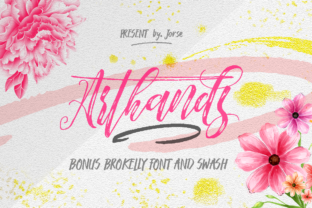
Arthands & Brokelly: Font Duo for Craft Projects
Some typefaces feel mechanical. They sit perfectly on the page, every letter identical, every curve calculated. Others feel as though someone drew them by hand in a quiet afternoon, with a cup of tea nearby and a stack of ideas waiting to be written. Arthands belongs to the second category. Paired with Brokelly, it forms a duo that brings warmth, texture, and a genuinely human rhythm to any project. Whether you are designing a wedding invitation, branding a small business, or building a personal blog, this combination offers something rare: the feeling that someone actually wrote it.
What makes Arthands interesting is not just its shape, but its inconsistency. The letters vary slightly, as if the writer paused, pressed harder, or let the pen linger on a curve. That natural flow makes it suitable for projects where you want to avoid the cold precision of standard typography. Brokelly complements this by adding a contrasting structure, giving you room to mix expressive headlines with readable supporting text. Together, they create a system that feels both spontaneous and deliberate.
What Arthands Brings to Your Work
Arthands is a handwritten-style font that captures the subtle imperfections of real writing. It does not try to be perfect. The letterforms have varying stroke weights, slightly uneven baselines, and organic connections that make each word feel like it was written in real time. This quality is hard to find in most digital fonts, which tend to smooth out the very details that make handwriting feel alive.
For creative professionals, this means you can use Arthands to convey authenticity. A brand that wants to feel approachable, personal, and trustworthy benefits from type that looks like it came from a person rather than a machine. For hobbyists and small business owners, the font removes the barrier between your idea and your audience. You do not need to be a trained designer to make something that looks intentional. Arthands does the work of making your text feel warm and accessible.
Brokelly adds balance. It is a cleaner, more structured font that works well for body text, captions, or any place where readability matters most. When you pair it with Arthands, you get a clear hierarchy. The headline catches attention with its natural movement, and the supporting text remains legible and calm. This contrast is what makes the duo so effective for real projects.
Practical Projects That Benefit from Natural Flow
The most immediate application for Arthands and Brokelly is in personal craft projects. Think of anything you might create by hand if you had perfect lettering skills: greeting cards, gift tags, scrapbook titles, journal covers, recipe cards, or wall art. With this duo, you get that handmade look without spending hours practicing calligraphy.
Consider a wedding invitation suite. The couple wants it to feel intimate, not corporate. Arthands can carry the main names and the invitation text, while Brokelly handles the date, location, and finer details. The result looks curated but personal, as if the couple wrote it themselves and then added clean notes for the logistical information. This same logic applies to baby shower invitations, birthday party flyers, or holiday cards.
For small business owners, the duo works well for product packaging, menu boards, signage, and social media graphics. A local bakery can use Arthands for the shop name on a cake tag and Brokelly for the ingredient list on the back. A freelance photographer can use it for watermark text or thank-you cards sent to clients. A craft seller on Etsy can create branded tissue paper, stickers, or business cards that feel consistent without looking overly designed.
Educators and workshop facilitators can use Arthands to create worksheets, handouts, or classroom decorations that feel inviting rather than institutional. A study guide or a creative brief typed entirely in a rigid font can feel intimidating. Replacing the headings with Arthands and keeping the body in Brokelly softens the tone while preserving clarity.
Adapting the Duo for Different Audiences and Platforms
The way you use Arthands and Brokelly should shift depending on who you are speaking to and where they will see your work. For a younger, creative audience on Instagram or Pinterest, you might lean into the expressive side of Arthands. Use it large, with generous spacing, and let it dominate the visual. Pair it with Brokelly in a smaller size for any explanatory text. This works well for quote graphics, mood boards, or product teasers.
For a more professional audience, such as clients viewing a brand proposal or a portfolio, you want to dial back the contrast. Use Arthands sparingly, perhaps only for a single word or a short headline, and let Brokelly carry most of the content. This approach signals that you understand both creativity and restraint. It shows you can be warm without being casual, and professional without being cold.
For print projects, consider the medium. On textured paper, Arthands gains even more character. The slight irregularities in the letterforms catch the light differently and feel more tactile. For digital use, test the font at different sizes to ensure it remains legible on small screens. Hand-drawn fonts can become muddy at very small sizes, so reserve Arthands for elements larger than 18 points and let Brokelly handle anything smaller.
Keeping Your Results Clear and Audience-Friendly
Natural flow is a strength, but it can become chaotic if you overuse it. The most common mistake people make with expressive fonts is using them for everything. If every word on the page has that handwritten quality, the eye has nowhere to rest. The message becomes exhausting to read. The remedy is simple: use Arthands for the elements that need personality and Brokelly for everything that needs clarity.
Establish a clear hierarchy before you start designing. Decide which words or phrases are the focal points. Those get Arthands. Everything else gets Brokelly. This rule alone will keep your projects organized and effective. If you want to add variation, try using different weights or sizes within the same font family, but resist the urge to introduce too many different styles. Consistency is what makes a design feel intentional.
Another practical tip is to pay attention to spacing. Handwritten fonts often need a bit more letter spacing than you think, especially when used in all caps or at larger sizes. Give the letters room to breathe. This prevents them from feeling crowded and preserves the natural rhythm that makes Arthands appealing in the first place. Similarly, line spacing should be generous enough that the text does not feel dense.
Creative Directions You Can Explore
Once you have the basics in place, you can start experimenting with different interpretations of the duo. One direction is to lean into the contrast between rough and smooth. Use Arthands in a slightly distressed or textured treatment, such as applying a subtle grain overlay, and keep Brokelly perfectly clean. This creates a tension that feels modern and editorial.
Another approach is to use color to reinforce the handmade quality. Warm earth tones, muted pastels, or soft neutrals pair naturally with the organic feel of Arthands. Bright neon or highly saturated colors can work too, but they shift the tone toward playful or bold. Think about the emotional response you want. A soft pink and cream palette with Arthands feels gentle and nostalgic. A deep navy and gold combination feels more sophisticated while still maintaining warmth.
You can also vary the layout. For a blog header, try stacking Arthands vertically or angling it slightly for a dynamic look. For a product label, wrap the text around a circular shape to mimic a stamp or a handwritten note. The font adapts well to non-linear arrangements because its natural irregularities make the text feel organic rather than forced.
Practical Recommendations for Getting Started
If you are new to working with font duos, start with a single project. Pick something small, like a thank-you card or a social media post, and commit to using only Arthands and Brokelly. This constraint will help you learn how the two fonts interact without feeling overwhelmed. Once you are comfortable, expand to larger projects like a logo concept or a multi-page document.
Test your combinations in grayscale first. If the hierarchy works without color, it will work even better with it. This also helps you see whether Arthands is legible at the sizes you plan to use. Adjust until the text is easy to scan, then add color as a final layer.
Keep a swipe file of projects that inspire you. Look for examples where handwritten fonts are used alongside clean sans-serifs. Notice how the designers handled spacing, sizing, and color. You do not need to copy them, but observing what works will train your eye to make better decisions with your own projects.
Finally, remember that Arthands is not trying to impersonate a machine. It is meant to look human. That means it is okay if your final design feels a bit loose, a bit uneven, a bit real. That is exactly the point. The people who see your work will sense that effort was made, that a person stood behind the message. In a world of automated templates and polished perfection, that warmth is what makes people stop and read.